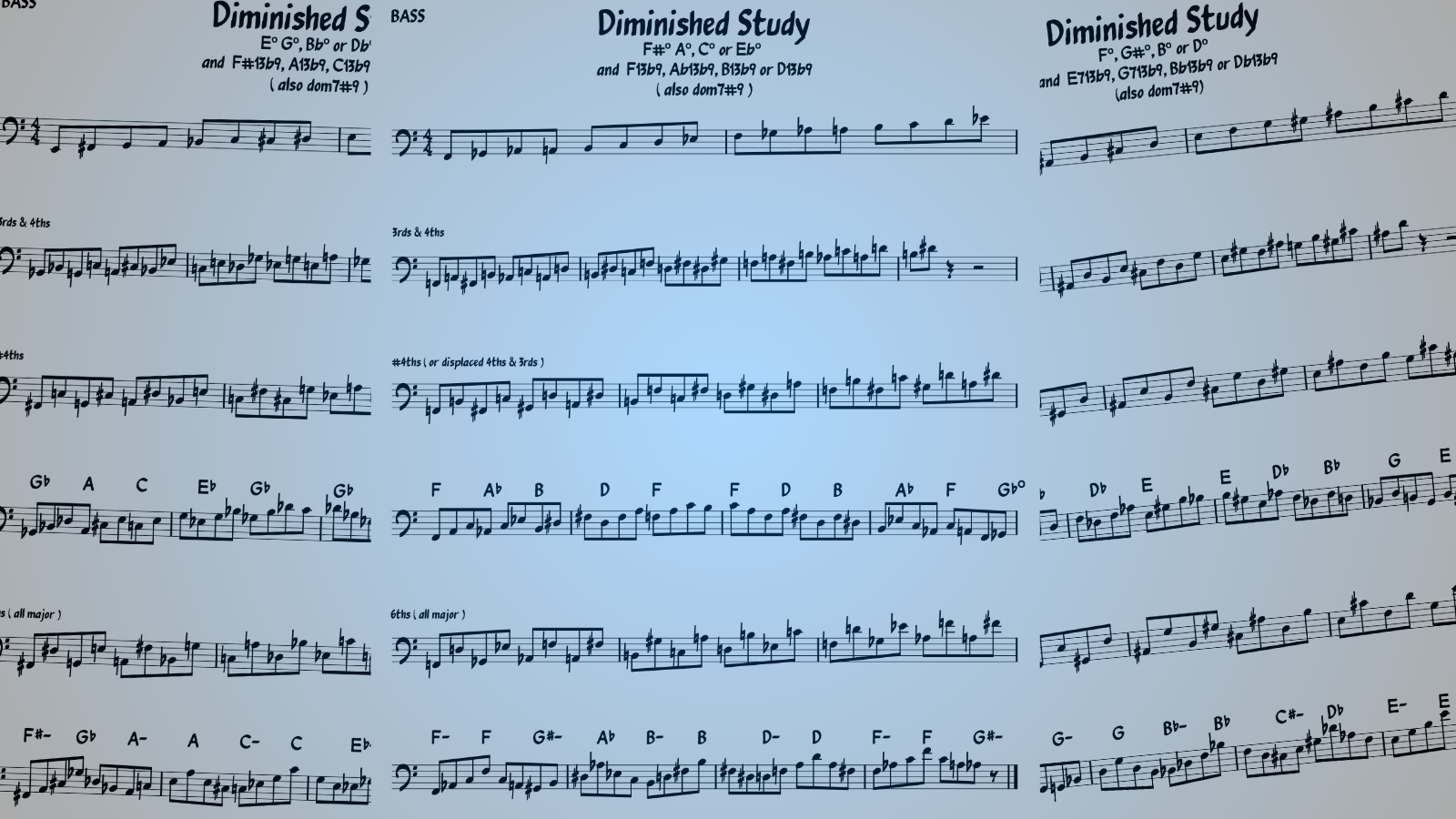
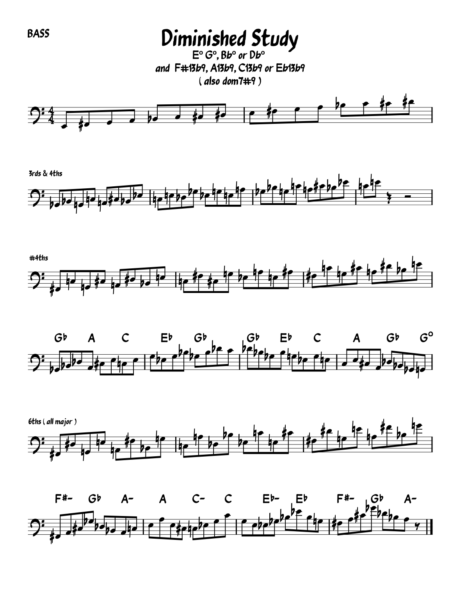
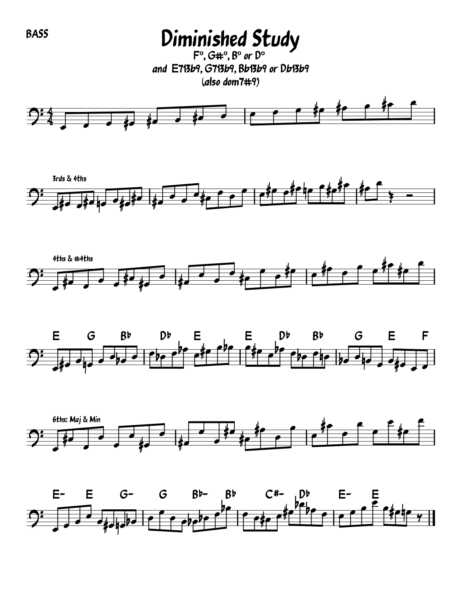
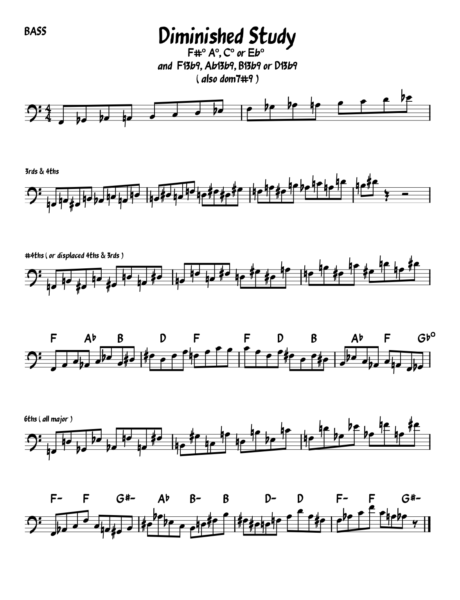
All 3 groups of symmetrical diminished (Eº/Gº/Bbº/Dbº, Fº/G#º/Bº/Dº, and F#º/Aº/Cº/Ebº), broken down into pattern exercises and hidden major/minor triads revealed.
After completing the last line of major/minor triads, try mixing up the chord symbols and exploring connections with your own triad inversions.
These exercises are designed to open more ways to improvise over diminished chords beyond just running linear scales and arpeggios. Diminished chords are usually used as passing chords and often only last for 1-4 beats, so don’t worry about squeezing it all in. Just enjoy more creative note choices to choose from. It may also help you recognize common tones the surrounding chords. Plus, the major/minor triad approach can also be applied to some dominant chords as well, which will often last a long time.
Memory tricks for real life application.
Anytime you see a diminished chord (ex. C#º), you can:
• Think a major or minor triad from a half-step below its root (C or C–)
• Think a major or minor triad from whole-step above (Eb or Eb–)
• Think a major or minor triad from a 4th above (Gb or F#–)
• Reconsider the root to be the major 3rd of a dominant 7#9 chord (A7#9)
When comfortable thinking of one related major triad, you find 3 more major triads all a minor 3rd apart. The same goes for minor triads.
When comfortable thinking of any related major triad, you can replace it with a minor triad, and vice versa.